The next stage of American democracy cannot be built on revenge.
And...it cannot be built on pretending nothing happened. Accountability matters.
The future of the United States cannot be built by dragging the country back into the same cage fight that got us here: left versus right, socialism versus capitalism, liberty versus equality, markets versus government.
That fight is theatrical. It is profitable. It fills cable news hours and fundraising emails. But it does not build strong democracies. It does not rebuild trust. It does not secure elections. It does not make billionaires pay taxes they legally owe. It does not repair bridges, lower healthcare costs, or stop the next president from turning public power into a personal weapon.
The work ahead is more serious than that.
If America is going to restore rule of law and rebuild a strong economy after the damage of the Trump era, we need a democracy agenda anchored in four pillars:
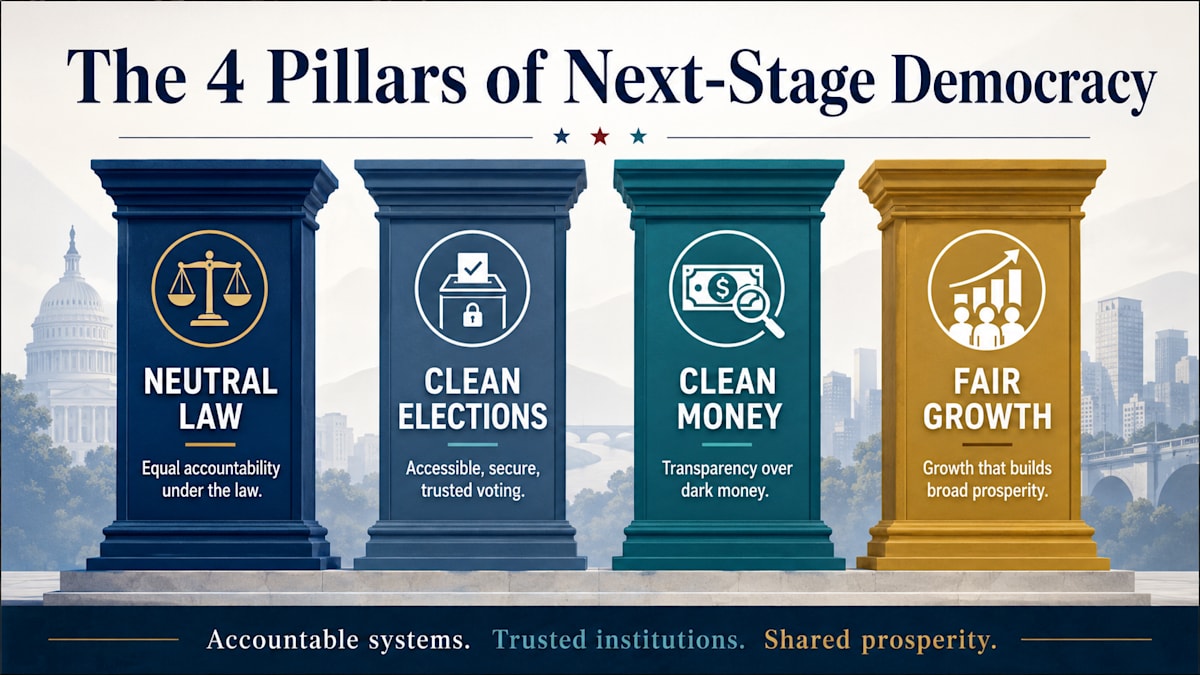
Neutral law. The law must apply to presidents, donors, corporations, protestors, immigrants, police, judges, and ordinary citizens with the same basic standard. No one above it. No one beneath it.
Clean elections. Voters must be able to vote, votes must be counted accurately, election workers must be protected, and losers must not be allowed to burn down public trust because they dislike the result.
Clean money. A democracy cannot remain healthy when billionaires, corporations, shell organizations, and dark-money networks can buy influence while hiding their fingerprints.
Fair growth. The economy must generate prosperity, distribute it fairly enough to maintain social cohesion, and adapt when conditions change.
That last point matters. Redistribution alone is not an economic strategy. Growth without fairness is not a social contract. A country has to do both. It has to create value and maintain enough legitimacy that people still believe the system is worth participating in.
That is one of the central arguments in my book, The Cage Fight Nobody’s Winning: Why Socialism vs. Capitalism Don’t Matter and How Strong Economies are Created. The strongest economies are not the purest economies. They are the most adaptive. They combine markets, rules, public goods, incentives, feedback loops, and social contracts in ways that fit their context.
The same is true for democracies.
The question is not, “Is this left or right?”
The question is, “Does this make the system more accountable, more adaptive, more legitimate, and more capable of solving real problems?”
Here are ten changes that belong at the top of the list.
1. Re-anchor the rule of law
The first repair is the most basic: the justice system must not be a weapon of the president.
That means rebuilding clear walls between the White House and the Department of Justice. Presidents can set broad law-enforcement priorities. They cannot order investigations of enemies, protect friends, or use prosecutors as political staff with subpoenas.
This also means we do not answer abuse with abuse.
If crimes were committed, investigate them. If evidence supports charges, prosecute them. If it does not, don’t. That is the rule.
The goal is not to create a revenge machine pointed in the other direction. The goal is to create a justice system boring enough, professional enough, and documented enough that the public can see the difference between accountability and retaliation.
Healthy accountability is not punishment dressed up as virtue. It is a fair process, well understood, consistently applied, and strong enough to teach the system what went wrong.
2. Secure elections without turning security into suppression
Election security matters. But the most secure election in the world is useless if eligible voters are pushed out of the process.
So the standard should be simple: make voting accessible, make counting verifiable, and make tampering difficult.
That means human-readable paper ballots or paper records. It means strong chain-of-custody procedures. It means risk-limiting audits where feasible. It means serious cybersecurity support for state and local election offices. It means protecting election workers from threats and harassment. It means making sure election administrators are not abandoned while conspiracy theorists turn them into targets.
But election security cannot become a costume for voter suppression.
A healthy democracy does not make voting needlessly difficult and then brag about “integrity.” Integrity means eligible citizens can vote, ballots are counted accurately, and the loser accepts the verified result.
A democracy that cannot count votes and accept outcomes is not a serious system. It is a grievance machine with flags.
3. Get dark money out of politics
Dark money is corruption with better stationery.
It allows people with extraordinary wealth to shape public life while hiding behind nonprofits, shell entities, pass-through organizations, and carefully laundered influence networks. The public sees the advertisement. It does not see who paid for the pressure.
That is not healthy democracy. That is a shadow market for power.
The fix is not mysterious. Require real disclosure for major political spending. Close pass-through loopholes. Make online political advertising transparent. Strengthen enforcement. Require beneficial ownership transparency. Make lobbying visible. Slow the revolving door between public office and the industries being regulated.
Some money in politics is inevitable. Hidden money does not have to be.
If your idea is good enough to shape public policy, your name should be good enough to stand behind it.
4. Rebuild the anti-corruption immune system
Every healthy system needs an immune system.
In government, that immune system includes inspectors general, auditors, ethics officials, whistleblowers, procurement officers, career lawyers, professional civil servants, and congressional oversight. These are not glamorous jobs. They do not make good campaign slogans. But they are the difference between a government that serves the public and a government that quietly becomes a feeding trough.
Corruption rarely begins with a manila envelope full of cash. It begins with exemptions. Waivers. Friendly contracts. Unexplained firings. Retaliation against truth-tellers. Public offices treated as family assets. Data hidden. Records deleted. Decisions made by people who will financially benefit from them later.
The repair is obvious but difficult: protect inspectors general from political retaliation, strengthen whistleblower protections, publish ethics waivers and recusals, enforce conflict-of-interest rules, and make government spending traceable.
Corruption thrives in fog. Turn on the lights.
5. Put limits back on emergency power
Emergencies are where democracies reveal their design flaws.
Every country needs the ability to act quickly in a crisis. But emergency power becomes dangerous when it is vague, renewable, and controlled almost entirely by the executive.
A president should not be able to declare an emergency, unlock extraordinary powers, and keep renewing those powers while Congress watches from the balcony.
Emergency powers should expire unless Congress affirmatively renews them. The legal theory should be public unless there is a genuine national security reason it cannot be. Domestic use of the military should be tightly constrained. Surveillance powers should be reviewed. Tariff, spending, and enforcement authorities should not become blank checks.
The issue is not whether we trust this president or that president.
The issue is whether we trust any president with tools that can be abused by the wrong one.
Design for the worst day, not the best person.
6. Protect a professional civil service
Democracy needs elections. It also needs competence.
One of the quiet dangers of authoritarian politics is the attempt to replace expertise with loyalty. The professional civil service becomes the enemy because it remembers the law, understands the systems, keeps records, and sometimes says, “No, Mr. President, you cannot do that.”
That is exactly why it must be protected.
A modern government cannot run on campaign slogans. It needs people who understand tax enforcement, disaster response, cyber threats, food safety, procurement, veteran benefits, aviation safety, public health, banking regulation, and infrastructure finance.
If every administration can purge professionals and replace them with loyalists, the state becomes stupid on purpose.
A strong democracy lets elected leaders lead. But it does not let them destroy the institutional memory required to govern.
7. Restore judicial legitimacy
Courts are the referee only if the public believes they are not wearing a team jersey under the robe.
Judicial legitimacy requires more than legal authority. It requires ethical credibility, transparency, and restraint.
That means stronger disclosure rules. Serious recusal standards. A binding ethics code. Transparency around gifts, travel, outside income, and conflicts. Lower courts already live with ethics rules; the highest court should not be the place where public accountability goes to die.
There are harder questions too: term limits, court expansion, jurisdiction stripping, and structural reform. Those require care because they can become partisan weapons if designed badly.
But basic ethics should not be controversial.
A judge who expects the public to respect the law should not be offended by the public asking who paid for the vacation.
8. Collect taxes already owed
Before we argue about raising taxes, we should collect the taxes already legally owed.
This is a rule-of-law issue, not just a budget issue.
Ordinary wage earners have taxes withheld automatically. Their income is visible. Their room for creative interpretation is limited. Wealthy individuals, complex partnerships, multinational corporations, offshore structures, and pass-through entities operate in a much more complicated world.
Complexity becomes camouflage.
A serious democracy funds the IRS well enough to answer the phone for ordinary taxpayers and audit the people with the most ability to hide income. That means modern technology, skilled personnel, legal expertise, and a focus on high-end noncompliance.
Tax enforcement should not be harassment. It should not be political. It should be competent.
If the law says you owe it, you owe it.
A country that cannot collect its own taxes cannot build state capacity. It cannot fund public goods. It cannot maintain legitimacy. It becomes a place where suckers comply and insiders negotiate.
That is not capitalism. That is decay.
9. Make the tax code more progressive and less gameable
The tax code should reward productive investment, not legal scavenger hunts.
America does not merely have a tax-rate problem. It has a tax-design problem. We tax labor more visibly than wealth. We allow too much income to be transformed, deferred, sheltered, inherited, or routed through structures ordinary citizens will never touch.
A fairer tax system would close high-end loopholes, strengthen estate and gift taxation, reduce the gap between how labor and capital are taxed, address carried interest, limit abusive pass-through shelters, and make multinational corporate profit-shifting harder.
The point is not to punish success.
The point is to stop confusing success with extraction.
Healthy capitalism requires competition, investment, innovation, and risk-taking. It does not require billionaires paying lower effective rates than teachers, firefighters, nurses, and small business owners.
When people believe the tax system is rigged, the social contract weakens. When the social contract weakens, politics gets uglier. When politics gets uglier, the economy becomes less stable.
Fairness is not a sentimental add-on. It is infrastructure.
10. Use revenue to build growth, not just redistribute income
Here is where the old cage fight gets especially stupid.
One side says, “Cut taxes and growth will solve everything.”
The other side says, “Redistribute wealth and fairness will solve everything.”
Both are incomplete.
Strong economies generate prosperity, distribute it fairly enough to maintain social cohesion, and adapt when conditions change. Miss any one of those three and the system becomes brittle.
So yes, tax the rich and corporations more fairly. Yes, close loopholes. Yes, reduce inequality. But then use the revenue to build future capacity.
Build housing where jobs exist. Modernize the grid. Invest in public health. Repair infrastructure before it collapses. Fund childcare so parents can work. Support apprenticeships, community colleges, and reskilling. Invest in basic research. Enforce antitrust so markets remain competitive. Lower healthcare costs so workers and businesses are not crushed by a broken sector. Build climate resilience before disasters force it at ten times the cost.
This is not redistribution versus growth.
This is redistribution that protects legitimacy and investment that expands capacity.
That is the next-stage economic agenda.
Not socialism.
Not trickle-down.
Not slogans.
Systems that work.
The deeper repair: build systems that can learn
The danger after Trump is that America treats the whole episode as a personality problem.
It was not only a personality problem.
It was a system problem.
A healthy system would not depend so heavily on presidential restraint. It would not leave election workers exposed. It would not allow hidden money to dominate politics. It would not make emergency power so easy to trigger and so hard to end. It would not tolerate a tax system where complexity protects the powerful. It would not let trust decay for decades and then act surprised when demagogues find an audience.
Trump exposed brittleness that was already there.
The repair must be deeper than replacing one person with another.
That is the argument I make in The Cage Fight Nobody’s Winning. Countries do not thrive because they win an ideological argument. They thrive because they build accountable systems that sense reality, correct errors, distribute decision-making intelligently, invest in long-term capacity, and maintain enough fairness that people continue to cooperate.
The same is true of companies.
The same is true of teams.
The same is true of democracies.
A strong democracy is not one where your side finally gets enough power to crush the other side. That is the cage fight talking.
A strong democracy is one where power is limited, money is visible, elections are trusted, institutions can learn, laws apply evenly, and the economy creates enough shared prosperity that people do not feel forced to choose between order and freedom.
The cage fight is not just exhausting.
It is making us stupid.
The next stage requires a better question.
Not “How do we beat them?”
Not “How do we get revenge?”
Not “How do we prove our ideology was right all along?”
The better question is this:
What would a democracy look like if it were designed to be accountable, adaptive, fair, and capable of solving real problems?
That is the work now.
The cage is open...almost.
Time to start thinking about building something better.