Last night, Democrats took back both the House and the Senate. Thank God. I mean that sincerely.
But by about 9 a.m. today, somebody in a Capitol Hill conference room will write a list of everything that needs fixing. It will be four whiteboards long. It will include campaign finance, health care, voting rights, ethics, the courts, prices, and a comprehensive accounting of the corruption and abuses of power under Donald Trump.
That list is where good majorities go to die.
Here's why.
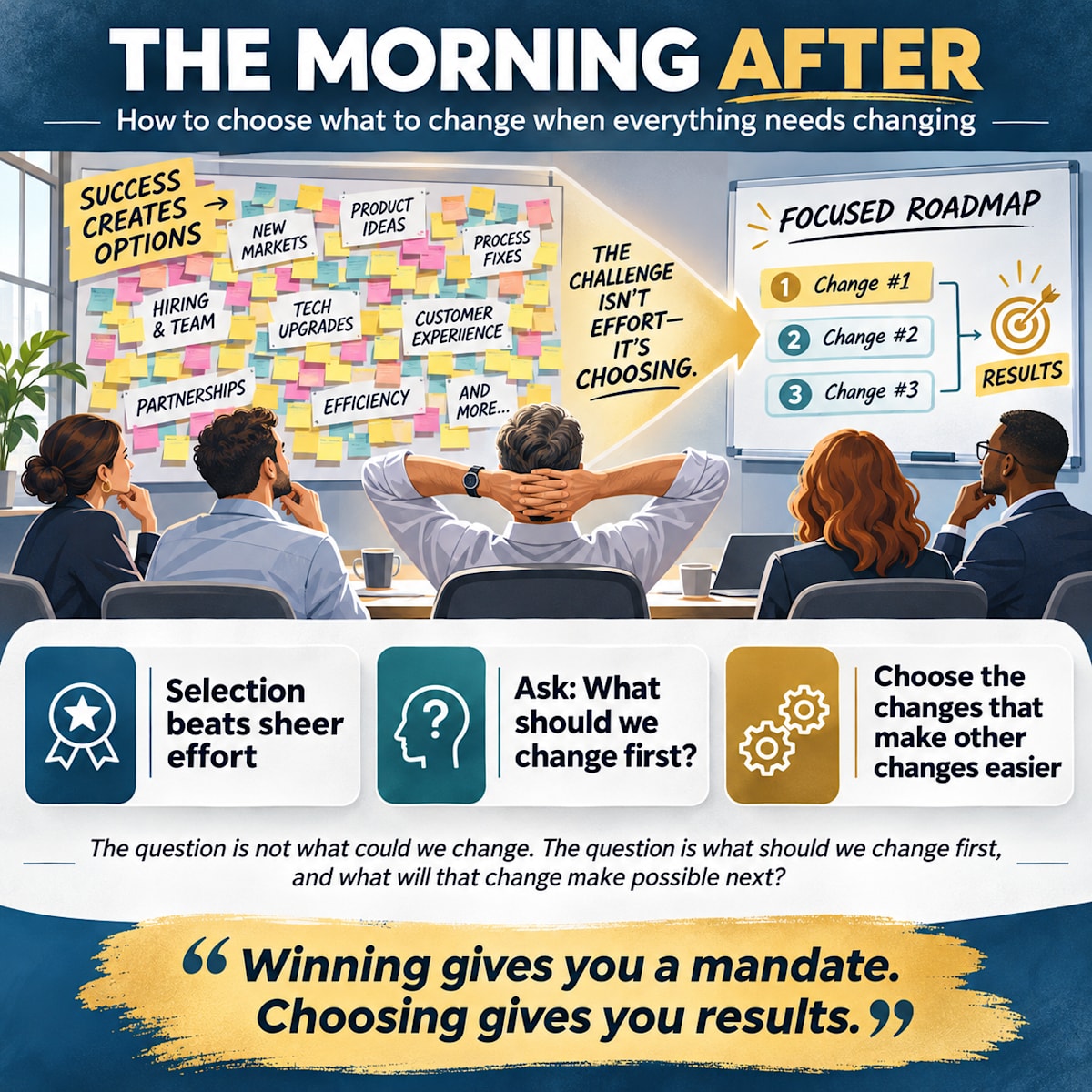
Whether you're an individual trying to change your life, a team trying to improve its performance, a corporation attempting a turnaround, or a political party that just won an election, you face the same problem: you always have more to change than you have the capacity to change.
Ignore that reality, and you can work yourself into exhaustion while accomplishing remarkably little.
This isn't a theoretical observation. It's forty years of change leadership talking. I've worked with organizations you've heard of, including Microsoft, Nike, Lockheed Martin, and Deloitte. I've seen what happens when leadership teams take change seriously. And I've seen what happens when they confuse being busy with making progress.
A new CEO arrives. A reorganization lands. A turnaround gets funded. The leadership team, drunk on a mandate, says yes to everything.
Eighteen months later, they're exhausted, the organization is cynical, and the scoreboard looks suspiciously like it did before.
They didn't fail from lack of effort. They failed from lack of selection. They got lost in the thick of thin things.
And that brings me back to the Democrats.
Accountability Is Necessary. It Is Not an Agenda.
Let's get something straight.
Holding Donald Trump and his administration accountable for corruption, abuses of power, and violations of the law is necessary. Congressional oversight is not optional, and neither is the rule of law.
But accountability cannot become the entire Democratic agenda.
If the next two years consist primarily of investigations, hearings, subpoenas, and a steady stream of revelations about what Trump did, Democrats may achieve something important while still squandering their opportunity to change the country.
Why? Because accountability and improving people's lives are not the same thing.
Americans still have to buy groceries, pay rent, afford medical care, and believe their children will have a better future.
A congressional majority that spends two years prosecuting yesterday without delivering a credible path toward tomorrow risks losing the very people who put it in power.
And this is where the discipline of change leadership matters.
You can be right about what needs fixing and still fail miserably at fixing it.
I've watched organizations do precisely that. They correctly diagnose twenty problems, launch twenty initiatives, spread their resources across all twenty, and then act surprised when none produce meaningful results.
The answer isn't to abandon accountability. It's to make accountability one part of a deliberately chosen change portfolio.
Some investigations may expose problems that require systemic reform. Others may consume enormous attention with little practical payoff. The difference matters.
The question isn't "What could we change?"
The answer to that is always "everything."
The question is "What should we change first, and what will that change make possible next?"
Here's the tool I've used to answer it.
The Change Impact Matrix
Two questions sort every opportunity on the whiteboard.
First, how much effort will it take to solve this problem and realize the benefits?
Second, how much impact will it have if it works?
Notice the fine print in that first question.
Effort doesn't stop when the bill passes, the policy is announced, the gym membership is purchased, or the corporate project kicks off.
It stops when the benefit shows up in real life.
Plenty of easy wins are easy to launch and miserable to land.
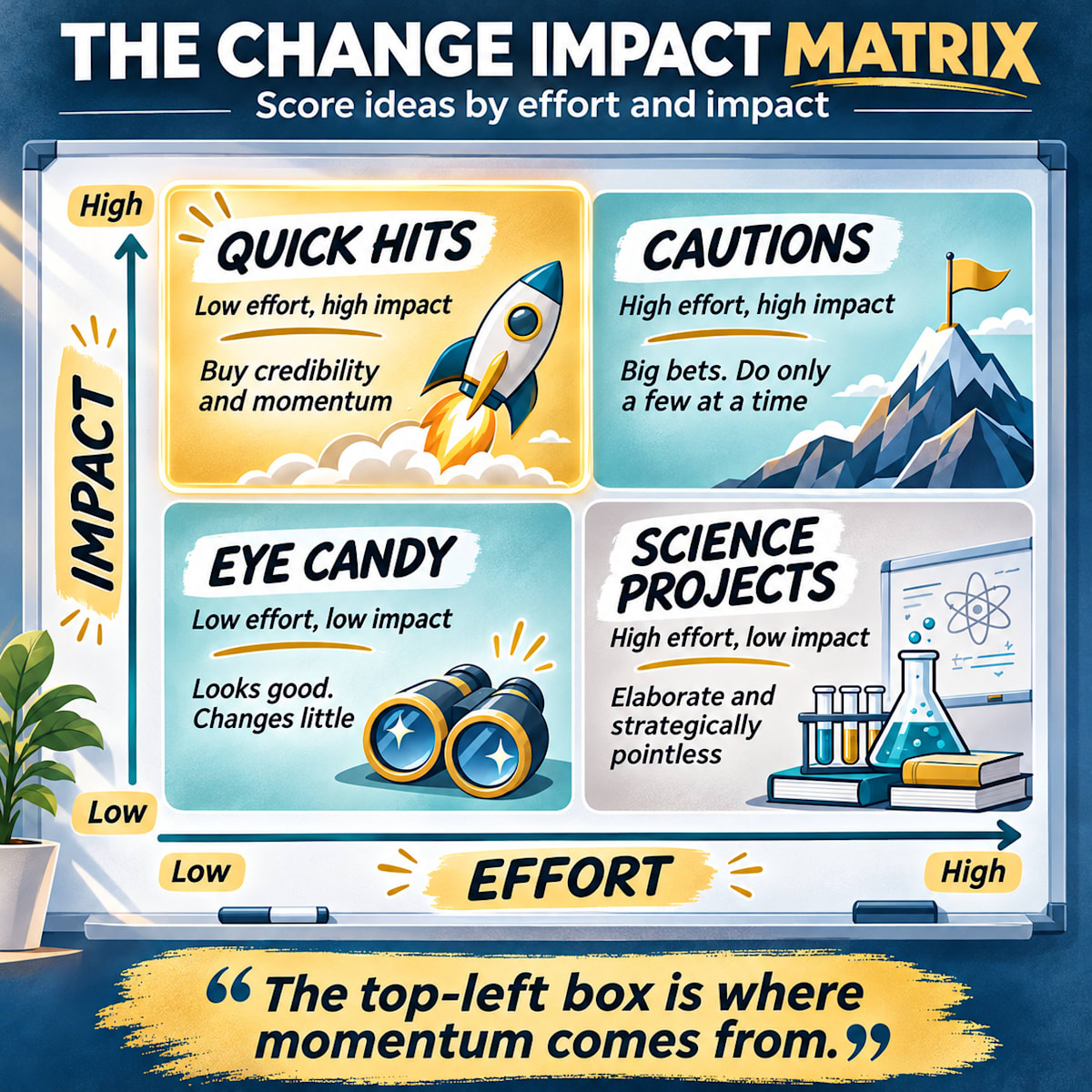
Put effort on the horizontal axis and impact on the vertical, and you get four neighborhoods:
Quick Hits (low effort, high impact). The gold. Small lift, real results, visible fast. This is how you buy credibility and momentum.
Cautions (high effort, high impact). The big bets. Transformational if they land, ruinous if you take on too many. Worth doing, but only a few at a time, with eyes wide open.
Eye Candy (low effort, low impact). Looks great in a press release. Changes almost nothing. Harmless in small doses, toxic as a diet.
Science Projects (high effort, low impact). The fascinating, the elaborate, the intellectually delicious, and the strategically pointless. These quietly eat budgets, careers, and political capital.
Every leadership team I've worked with already has opportunities in all four boxes. So does every individual, every corporation, and every newly elected congressional majority.
The difference between those who make meaningful progress and those who merely wear themselves out is which boxes they spend in.
Feed the Momentum, Ration the Cautions
Here's a rule I give leadership teams:
You may take on a few Cautions, but you must feed the need for real momentum.
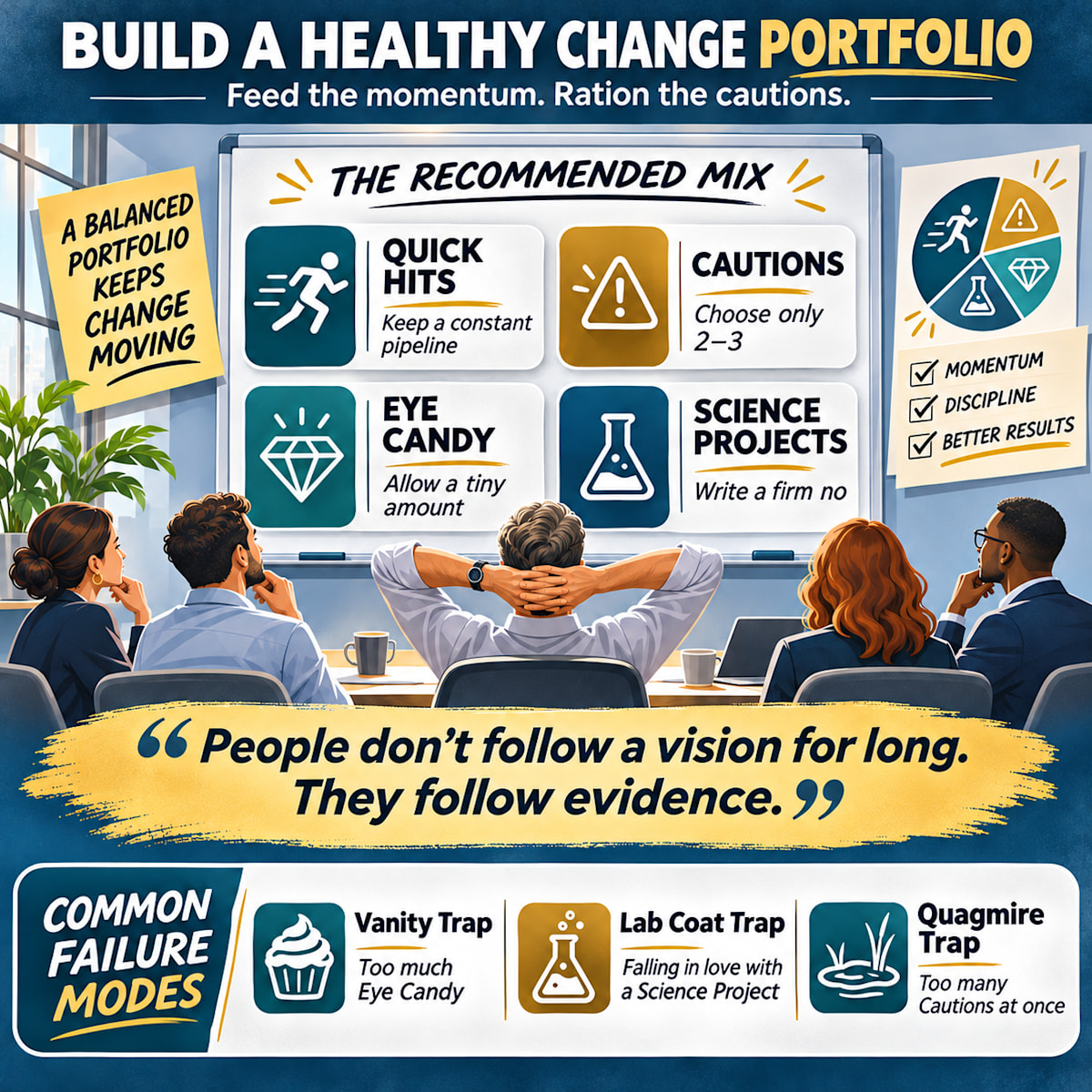
People don't follow a vision for long. They follow evidence.
A steady drumbeat of Quick Hits provides that evidence. It tells employees, customers, voters, and, frankly, the leaders themselves that this time is different.
It also builds the credibility, goodwill, and stamina you'll need when the big Caution projects hit their inevitable swamp in month nine.
Consider an individual trying to get healthy. They could launch a punishing diet, a six-day exercise program, a complete sleep overhaul, and a dozen other lifestyle changes on Monday.
By Thursday, they're negotiating with a pizza.
Or they could start with a daily walk, eliminate sugary drinks, and establish a consistent bedtime. Small changes, tangible results, growing confidence. Then build on what works.
The same principle operates in billion-dollar organizations. And Congress.
The failure modes are predictable enough to set your watch by:
The Vanity Trap. Too much Eye Candy. Lots of ribbon-cutting, lots of announcements, very little anyone can feel at the kitchen table. The audience notices. Usually around the next election.
The Lab Coat Trap. A brilliant team falls in love with a Science Project because it's interesting. It is interesting. It's also eating the calendar.
The Quagmire Trap. Ambition outruns capacity. Six Cautions launch at once, none gets enough oxygen, and all stall at 60 percent. Sixty percent of six transformations is zero transformations.
A healthy change portfolio looks like this: a constant pipeline of Quick Hits, a short list of carefully chosen Cautions (two or three, not ten), a tiny allowance for Eye Candy because humans like a parade, and a firm, polite "no" to Science Projects.
Write that "no" down. You'll need it again next quarter.
The Raise-All-Boats Test
The matrix tells you where an opportunity sits. It doesn't tell you what it unlocks.
For that, ask one more question:
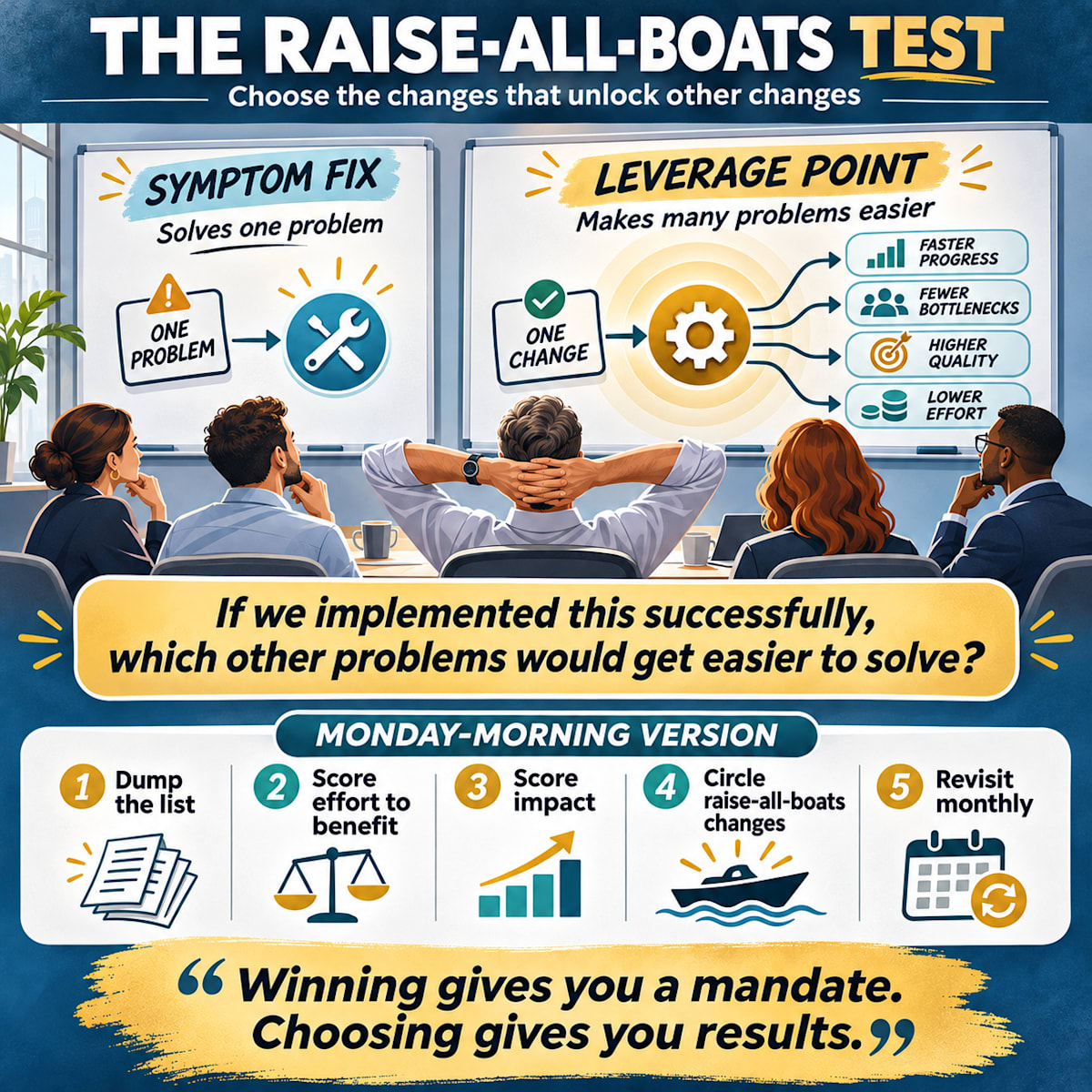
If we implemented this successfully, which other problems would get easier to solve?
Systems thinkers call these leverage points. Donella Meadows built a famous essay around them.
I call them raise-all-boats changes, because when the tide comes in, you don't have to lift each boat by hand.
Most items on a leadership whiteboard are symptoms. A few are upstream causes.
Fix a symptom, and you fix one problem.
Fix an upstream cause and a dozen symptoms may start healing on their own, sometimes ones you didn't even know were connected.
In American politics, one of the clearest examples is money.
Reducing the influence of dark money in politics, and ultimately addressing the effects of Citizens United, isn't just another item on the list. It's a problem underneath much of the list.
As long as enormous sums of political money influence who runs for office, who gets elected, and which issues lawmakers are willing to confront, reforms in other areas face additional obstacles.
Drug prices. Climate policy. Banking rules. Gun policy. Tech regulation.
Pick your cause, and political money is probably somewhere in its plumbing.
Other raise-all-boats candidates share the same signature. They change the rules of the game rather than the score of one match.
Fair districts. Reduce partisan gerrymandering and more representatives must compete for voters beyond their party's base. That can change incentives across an enormous range of issues.
Voting access and integrity. Make it easier for eligible citizens to vote securely and fairly, and you strengthen both democratic legitimacy and political accountability.
Ethics that actually bind. Meaningful restrictions on lawmakers trading individual stocks, stronger financial disclosures, and an enforceable ethics framework for Supreme Court justices could help rebuild the public trust that other reforms depend on.
Here's the useful twist.
Raise-all-boats changes can live in any quadrant.
Some are Quick Hits hiding in plain sight. Others are Cautions worth every ounce of effort.
Score them on the matrix, then give them a thumb on the scale.
Because the best changes don't merely solve problems. They improve your capacity to solve the next ones.
Running the New Congress Through the Matrix
Let's make this concrete.
Democrats have won control of Congress. But the White House remains in Republican hands, and the Senate's 60-vote cloture threshold still applies to most legislation.
That means the effort must account for political resistance, veto risk, implementation capacity, and the likelihood of achieving actual results.
A bill that is easy to write but impossible to enact is not necessarily a Quick Hit.
Neither is an investigation that produces terrific television and nothing else.
Quick Hits: Start Here, Start Now
A serious congressional ethics initiative. Each chamber controls important elements of its own procedures and internal rules. Stronger disclosure, oversight, and member conduct requirements are places to begin, even where broader statutory reforms require cooperation across government.
Oversight with a destination. Investigate credible allegations of corruption and misconduct. Use subpoena power, gather evidence, establish facts, make referrals where warranted, and develop legislative remedies.
But give investigations a purpose beyond generating the next viral clip.
Use the Senate confirmation gate. The Senate majority has meaningful authority over nominations to the courts and executive branch. Exercise that responsibility deliberately, with clear standards and public accountability.
Advance visible kitchen-table priorities. Prescription drug costs, affordability, and other tangible economic pressures deserve early attention. Even where legislation faces a presidential veto, serious proposals can establish meaningful choices and build support for future action.
The key is the outcome.
A Quick Hit should create something people can recognize as progress, not simply another announcement from Washington.
Cautions: Pick Two or Three and Commit
Campaign finance reform. Greater transparency around political spending could reduce opportunities for undisclosed influence. A constitutional amendment addressing Citizens United would be far more difficult, requiring two-thirds support in both chambers and ratification by three-quarters of the states.
That is not a two-year project. It is a long-term structural undertaking.
Ending partisan gerrymandering. More competitive districts could change the incentives that drive polarization and legislative behavior. High effort, potentially enormous residual impact.
Systemic accountability reforms. Oversight may reveal weaknesses in the rules governing conflicts of interest, executive authority, or institutional independence. Turning those findings into durable safeguards could be worth substantial effort.
These are serious undertakings.
But here's the problem: if Democrats embrace every transformational cause simultaneously, they risk transforming nothing.
Choose. Sequence. Deliver.
Eye Candy: Allowed in Moderation
Messaging bills written only to be vetoed, with no plan beyond the press release.
Commemorative resolutions and post office renamings. Fine on a slow Tuesday.
Hearings staged for the viral clip rather than the findings.
Political theater has its place. Just don't confuse applause with impact.
Science Projects: Say No, in Writing
The 2,000-page grand rewrite of everything, destined for a veto and a bookshelf.
Investigations with no endpoint: no report, no referral, no legislation, no accountability mechanism, just hearings forever.
You may sort a few of these differently.
Good.
Arguing about where an item belongs is half the value of the exercise, because it forces a leadership team to say out loud what it believes about effort, impact, capacity, and the probability of success.
Those conversations should happen before the initiative launches.
Not eighteen months later, when everyone is wondering why nothing changed.
The Real Danger: Doing Too Much and Accomplishing Too Little
Let me return to something I've learned over four decades of helping organizations change.
The biggest threat to successful change is often not resistance. It's overcommitment.
People assume that if a problem is important, they must act on it immediately. If ten problems are important, they launch ten initiatives.
That sounds responsible. It isn't.
Every change consumes time, leadership attention, money, organizational energy, and credibility. Those resources are finite, whether you're managing your personal life or running the United States Congress.
Overload the system, and execution suffers.
Worse, people become cynical. They stop believing the next initiative will be any different from the last one.
This is why momentum matters so much. An individual who sees progress keeps going. A team that experiences early success becomes more willing to tackle difficult problems. A company that delivers measurable improvements earns the confidence to pursue a major transformation.
And a political party that produces tangible results earns the credibility to ask voters for another opportunity.
The point of prioritization isn't to lower your ambitions. It's to increase the odds of realizing them.
That's a distinction too many leaders miss.
Your Monday-Morning Version
You don't need a congressional majority to use this. You need a whiteboard, some honest thinking, and about ninety minutes.
- Dump the list. Every opportunity, complaint, unfinished promise, and pet project. Get it all out where you can see it.
- Score effort to benefit, not effort to launch. Ask what it will take until the value actually shows up.
- Score impact. Be ruthless. "It would be nice" is not impact.
- Plot everything. Watch how much lands in Eye Candy. It's usually more than people expect.
- Run the raise-all-boats test. Circle anything that would make several other problems easier to solve. Those deserve special attention.
- Build the portfolio. A pipeline of Quick Hits, two or three Cautions, a sliver of Eye Candy, and a written "no" to the Science Projects.
- Revisit monthly. Effort and impact shift as circumstances change. Last quarter's Caution can become this quarter's Quick Hit.
And one more thing.
Make sure somebody owns the results.
Not the announcements. Not the activities. Not the reports.
The results.
If nobody is accountable for ensuring the benefits actually materialize, you haven't created a change plan.
You've created a wish list with deadlines.
Winning Gives You a Mandate. Choosing Gives You Results.
Democrats have a rare opportunity. They also face a trap.
They can spend the next two years trying to address every injustice, investigate every abuse, and tackle every problem that has accumulated under the Trump administration.
They might even be right about most of them. But being right isn't the same as being effective.
Holding Trump accountable is necessary. So is governing, rebuilding public trust, and demonstrating that the country can work better for ordinary people.
That requires choosing what matters most, what can actually be accomplished, and what will make subsequent changes easier.
And the lesson isn't reserved for Democrats.
It's equally true for a Republican majority, a Fortune 500 executive, a struggling nonprofit, a team leader, or someone standing in front of a bathroom mirror promising to finally get their life together.
You cannot fix everything at once. Try, and you may end up fixing very little.
I've spent forty years watching talented, committed, intelligent leaders discover that lesson the hard way.
The successful ones learned to make hard choices, build visible momentum, and focus their efforts where they could achieve the greatest impact.
The others stayed extraordinarily busy.
Winning gives you a mandate. Choosing gives you results.
So pick your battles like they matter.
Because they do.