There's a story about a man who left a rigid fundamentalist community after twenty years. When someone asked him what finally made him walk out the door, he said, "I realized I'd met the same person in four different religions."
He wasn't talking about a specific individual. He was talking about a type.
Eric Hoffer saw it coming. In 1951, the San Francisco dockworker and self-taught philosopher published The True Believer, a slim book that remains one of the most unsettling works of social psychology ever written. His argument, stripped to its frame: mass movements are interchangeable. A frustrated soul who becomes a committed revolutionary could just as easily have become a devoted nationalist or a religious zealot. The specific doctrine matters far less than most people think. What matters is the relationship to certainty.
Hoffer was onto something. And after decades of working inside organizations, consulting with leaders across industries, and doing some personal excavation of my own, I'd put it even more plainly. True believers, regardless of what they believe in, run the same operating system. The content differs. The architecture does not.
Here's what the common patterns or architecture looks like for Mormons, MAGA, or Muslims.
Certainty as identity. For a true believer, the belief is not something they hold. It is something they are. Which means doubt is not an intellectual challenge to be considered. It is an existential threat to be neutralized. This is why true believers often respond to questions not with curiosity but with something that looks, at close range, a lot like panic.
In-group and out-group as the organizing principle of reality. Everyone, everywhere, gets sorted. The in-group is enlightened, chosen, righteous, awake. The out-group is deceived, corrupt, lost, or simply the enemy. Social life organizes entirely around this sorting. Friendships outside the group become suspect. Relationships inside the group become loaded with surveillance. The world narrows.
Teleological urgency. History has a direction, and the true believer knows which side they are on. The stakes are cosmic, the timeline is pressing, and this urgency makes ordinary ethical constraints feel optional. Things that would have seemed wrong before the conversion become not just acceptable but necessary.
Deference to interpretive authority. Someone or something holds the keys to correct understanding. A leader, a text, an institution, an inner circle. The true believer learns, often quickly, that independent reasoning is reframed as arrogance or spiritual failure. The safest cognitive move is always to defer upward.
Moral licensing. Once you're on the right side of history, a lot of doors open. Deception becomes strategy. Coercion becomes guidance. Harm to individuals becomes necessary sacrifice for the greater good. This is the cluster that produces the most damage, and it operates in political movements with the same mechanism it operates in high-demand religious communities.
Exit costs, carefully managed. This one is the least discussed and possibly the most important. Every robust belief system, whether it is a religion, a political movement, or a corporate cult, builds exit costs into its structure. These are the mechanisms that make leaving genuinely painful. Shunning by community. Loss of social networks built over years or decades. Reputational consequences. Financial entanglement. The deep psychological cost of admitting that significant portions of your life were organized around something that turned out to be wrong. These costs are not accidents. They are features.
The exit cost architecture is what keeps people inside systems they have already stopped fully believing. And it is what makes departure, when it finally happens, feel less like liberation and more like surgery without anesthesia.
What is worth sitting with, before you get too comfortable with the "these people" framing, is this: the same attributes that make true belief look alarming from the outside look remarkably different from inside. Certainty feels like clarity. The in-group feels like belonging. Urgency feels like purpose. Deference feels like wisdom. Moral licensing feels like conviction. And the exit costs feel, until the moment they don't, like good reasons to stay.
Nobody joins a harmful system on purpose. They join something that meets real human needs, through a mechanism that happens to not care what banner it operates under.
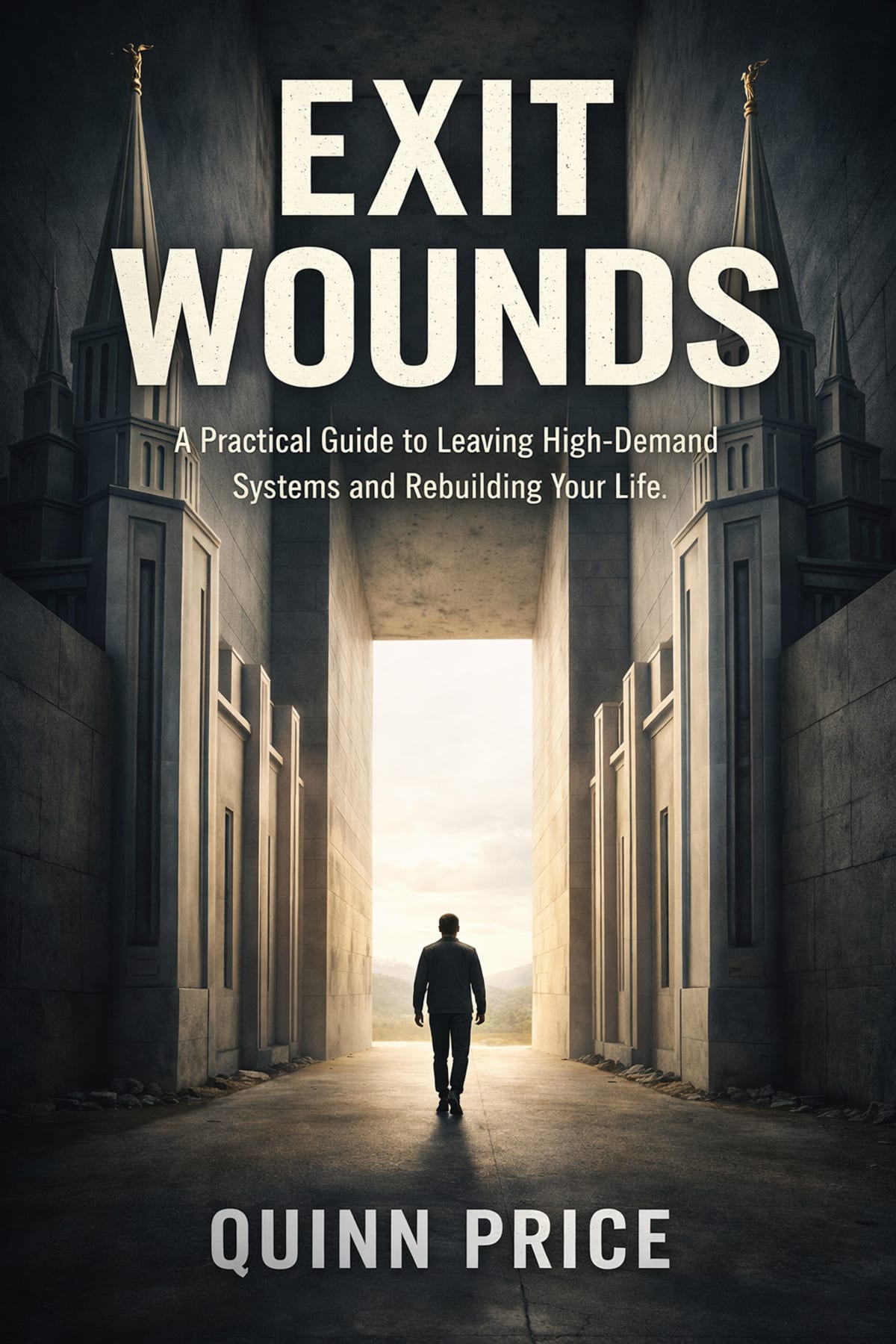
That is the conversation my book Exit Wounds is trying to have. Not a polemic. Not a finger-pointed at any particular tradition or ideology. A map of the territory, written by someone who has spent time in it, for anyone navigating the complicated work of leaving something behind.
If any of this feels familiar, you are not alone. And the door, despite what you may have been told, does not lock from the outside.
Exit Wounds is available now..