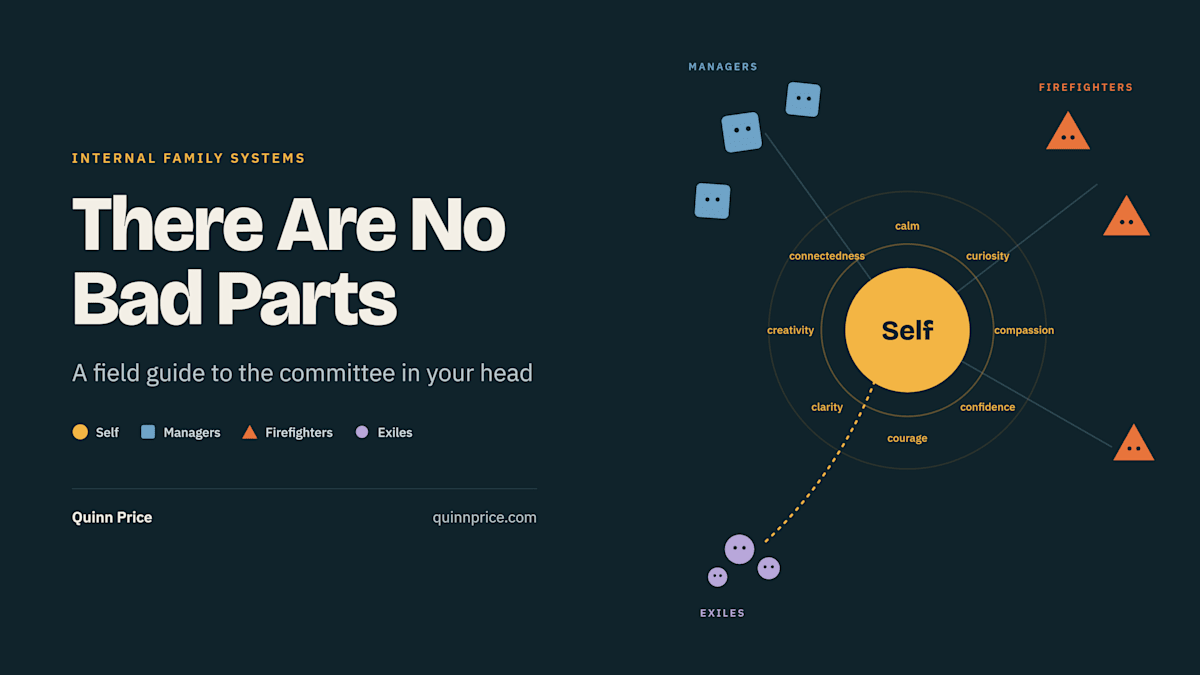
You are not one person. You are a committee. If you are paying attentions to the energy of your inner world, you know what I'm talking about. Let's learn about healing today.
According to Dr. Richard Schwartz, the "committee" is the normal architecture of a human mind. Schwartz created Internal Family Systems, or IFS, and after four decades of helping organizations change, I think it's one of the most useful maps of the inner world anyone has drawn. It explains why smart people do self-defeating things, why willpower fails, and why resilience has less to do with toughness than most of us were taught.
This post is a field guide: where IFS came from, how the model works, and the specific interventions Schwartz teaches. I'll also show you why versions of these ideas keep turning up in my resilience series.
Where IFS Came From
In the early 1980s, Schwartz was a family therapist. He was trained to see families as systems, where every member plays a role and even the strangest behavior makes sense once you see the whole picture.
Then his clients, many of them struggling with bulimia, kept saying something odd. They talked about "a part of me" that wanted to binge. Another part criticized them afterward. A third felt hopelessly empty underneath it all.
These parts weren't random. They formed alliances, picked fights, and protected the vulnerable, exactly like members of a family. So Schwartz made the leap: the mind itself is a family system. IFS didn't invent a new disorder. It took systems thinking and turned it inward.
The Core Model: Meet Your Committee
IFS rests on three ideas that sound gentle and turn out to be radical.
The mind is naturally multiple. Having parts isn't a symptom. Everyone has them. Trouble starts when painful experiences force parts into extreme roles they never asked for.
There are no bad parts. This is the moral center of the model, and the title of Schwartz's 2021 bestseller. Every part is trying to help, including the one that drinks, rages, or torpedoes your career. The strategy may be terrible. The intention is protective.
Everyone has a Core Self. Beneath the parts sits a core that trauma can hide but never destroy. Schwartz describes it with the "8 C's": calm, curiosity, compassion, confidence, courage, clarity, creativity, and connectedness. The goal isn't to fire your parts. It's Self-leadership: a calm, warm leader running the meeting instead of whoever shouts loudest.
The Three Roles
Parts tend to fall into three job descriptions.
- Exiles are young, wounded parts carrying pain, shame, terror, or worthlessness from the past. The system locks them away because their feelings threaten to flood everything.
- Managers are proactive protectors. They try to make sure exiles never get triggered, which looks like perfectionism, control, people-pleasing, inner criticism, and planning that never ends.
- Firefighters are reactive protectors. When an exile breaks through anyway, they put the fire out fast with whatever works: bingeing, dissociation, rage, substances, compulsive scrolling.
Managers and firefighters usually can't stand each other. The manager says "stay disciplined," the firefighter grabs the ice cream, and the manager spends the next morning yelling about it. Sound familiar? That loop is how people get stuck.
Burdens
The painful beliefs and feelings parts carry are called burdens. Here's the hopeful part: burdens aren't built into the part. They were picked up, so they can be put down. Schwartz also describes legacy burdens, inherited from family, culture, or history. Think of a family rule like "we don't show weakness," passed down three generations without anyone remembering who wrote it.
The Field Guide: How IFS Actually Works
This is where IFS earns its reputation. The therapist doesn't interpret your psyche from on high. The job is to help your Self do the healing directly.
1. Unblending: Get Some Distance
When a part takes over, you're "blended" with it. Furious people don't feel like they have an angry part. They just are angry. Unblending means noticing the part as a part. A therapist might ask, "Where do you notice that in your body?" or "Can you see it or sense it?" Once there's a little space, the part becomes someone you can talk to instead of the lens you're seeing through.
2. The Self-Energy Check
The most important question in IFS is almost embarrassingly simple: "How do you feel toward this part?"
If the answer is curious, open, or compassionate, Self is in the room and the work can begin. If the answer is "I hate it" or "I want it gone," another part has hijacked the conversation. The therapist asks that part to step back, promising nothing will happen without its permission. Repeat until genuine curiosity shows up.
3. The 6 F's: Getting to Know Protectors
Work with managers and firefighters follows a sequence known as the 6 F's.
- Find the part in or around the body.
- Focus attention on it.
- Flesh it out by noticing its image, age, voice, or sensations.
- Feel toward it, which is the Self-energy check.
- Befriend it by asking what it does, how long it's done it, and what it's trying to achieve.
- Fear: ask, "What are you afraid would happen if you stopped doing this job?"
That last question is the doorway. The answer almost always points straight at the exile the protector is guarding.
4. Ask Permission
IFS is unusually polite to protectors. Before anyone approaches an exile, the protector is asked for permission. If it says no, its worries get addressed, not bulldozed. Common worries: the pain will be overwhelming, the person will fall apart, or the protector will lose its job.
As a change consultant, I love this. Resistance is treated as information, not opposition. Go around protectors and you get backlash. Work with them and you get safety. Any leader who has tried to force a reorg past a skeptical middle-management layer already knows this lesson.
5. Heal the Exile: The Unburdening Sequence
Once protectors agree, the client's Self approaches the exile, and a recognizable sequence unfolds.
- Witnessing. The exile shows or tells what it wants known about what happened. Self keeps listening until the exile feels fully understood. This isn't a cognitive retelling. It's being seen by someone compassionate, often for the first time.
- Do-over. If needed, Self steps into the old scene and gives the exile what it needed back then: protection, comfort, someone standing between it and harm.
- Retrieval. The exile leaves that past scene and comes somewhere safe in the present.
- Unburdening. The exile is asked whether it's ready to release what it's been carrying, and where it wants to send it: light, water, fire, earth, or wind. People often feel a real physical shift here.
- Invitation. The part takes in new qualities to fill the space, such as playfulness, courage, or joy.
- Protectors revisited. The protectors, who've been watching nervously, notice they're off duty. The inner critic might become a wise advisor. The firefighter might finally take a nap.
6. Work the Polarizations
When two protectors are locked in combat, say one pushing you to work eighty hours and another shutting you down with exhaustion, Self acts as mediator. Each part gets heard. Often they talk to each other with Self present. They usually discover they're guarding the same exile and have been arguing about strategy all along.
7. Direct Access When Needed
Most IFS work happens through in-sight: the client's Self talks to parts internally while the therapist guides. When a protector won't let Self through, the therapist uses direct access and speaks to the part itself: "Can I talk to the part that thinks this is a waste of time?" It's the side door for a guard who won't open the front gate yet.
8. The Therapist's Own Self
Schwartz insists that the therapist's Self-leadership is itself an intervention. An anxious, impatient, or fix-it-now therapist sets off the client's protectors. A calm, curious one creates safety. That's why IFS training spends real time on practitioners doing their own parts work. The same is true for leaders, by the way.
9. The U-Turn: Speak For Parts, Not From Them
In relationships, the core skill is the U-turn. When someone triggers you, turn attention inward to the part that just lit up. Then speak for it ("A part of me feels dismissed when that happens") instead of from it ("You never listen!"). One sentence, completely different conversation. Try it in your next tense meeting and watch the temperature drop.
Why This Shows Up in My Resilience Series
I write adventure novels that teach resilience, and if you've read them, some of this may feel familiar. Versions of these ideas run all through the series, mostly without the clinical vocabulary.
That's deliberate. A good adventure story is basically an IFS session with explosions. The hero starts blended with a protector: the loner who trusts no one, the overachiever who can't stop, the joker who deflects every hard moment. Those protectors keep the hero alive in Act One. By Act Three, they're the very thing standing between the hero and what they need to do.
So my characters don't win by crushing their weaknesses. They win when they get curious about them. They learn what their protectors are afraid of. They go back, sometimes literally, to the moment a younger version of themselves got stuck. And they lead from a calmer, clearer place when the stakes are highest. That's the arc readers feel, even if they've never heard the word "exile."
I think fiction may be the best delivery system for these ideas. Nobody's protectors get defensive watching a fictional character unblend. You get to rehearse the skill safely, at a distance, and then one day you catch yourself doing it in real life.
The Evidence, and a Word of Caution
IFS isn't just a nice metaphor. In 2015 it was listed as evidence-based in SAMHSA's National Registry of Evidence-based Programs and Practices. Studies have shown promising results for PTSD, depression, and symptoms of rheumatoid arthritis.
That said, the research base is young and mostly built on small studies. Exploring your parts with curiosity is safe for most people. Deep unburdening work around serious trauma deserves a trained practitioner and careful pacing. Your protectors earned their caution. Respect it.
Where to Go Next
- No Bad Parts (2021): the most accessible introduction, with exercises you can try on your own.
- You Are the One You've Been Waiting For (2008): IFS applied to intimate relationships.
- Internal Family Systems Therapy, 2nd edition, with Martha Sweezy (2020): the clinical text.
- The IFS Institute, founded by Schwartz: training and a directory of practitioners.
The Bottom Line
Most of us were taught that resilience means overpowering the parts of ourselves that freeze, avoid, or sabotage. IFS offers a better deal. Much better. Those parts are overworked protectors who never got relieved of duty. Resilience isn't about shouting them down. It's about leadership: a calm, curious Self who can hear every voice on the team without handing any of them the car keys.
If you think in systems, this will feel familiar. It's organizational effectiveness applied to the psyche, complete with turf wars, legacy culture, and a leader who finally stops yelling.
So here's your homework. The next time a part of you takes over, try one question: "How do I feel toward this part?" Then get curious about the answer. Your committee has been waiting a long time for someone to chair the meeting.