Trump's current approach to immigration won't last for two reasons; he won't last and few support this un-constitutional bully tactics that include concentration-type incarceration. Once the nightmare enforcement is over, we still have a broken system.
First, what would the system be designed to do? A serious immigration system has four things i must do:
- protect the border,
- protect due process,
- meet labor-market realities, and
- fair and effective enforcement.
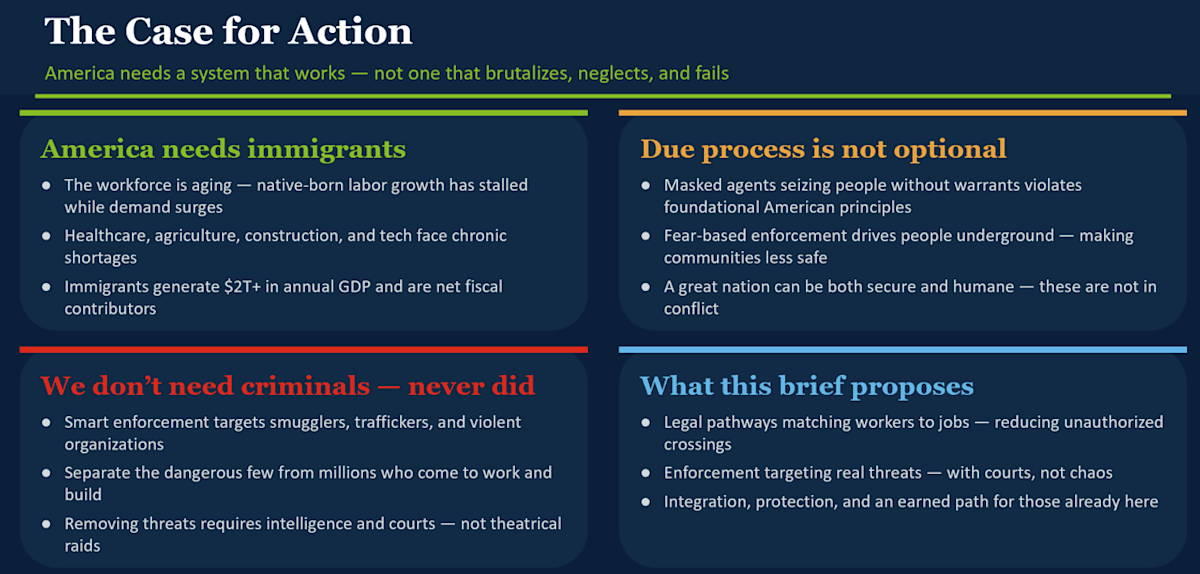
If the U.S. wants a credible post-Trump reset, the workable model is not “less immigration” versus “more immigration.” It is a managed migration system that expands lawful entry, restores due process, sharply narrows who gets detained, and aligns admissions with labor demand and national capacity. That approach fits the data: foreign-born workers were 19.2% of the U.S. civilian labor force in 2024, and 70.3% of that labor force was prime working age (25–54). Census also said U.S. population growth slowed to 0.5% between July 2024 and July 2025 because net international migration fell, while CBO projects that net immigration will drive most U.S. population growth over 2025–2030.
Here is what a holistic design would look like.
1) Set one national immigration strategy instead of running four disconnected systems
Four? Congress would adopt a plan with separate lanes for economic immigration, family immigration, humanitarian protection, and temporary labor. An independent Migration and Labor Commission would publish annual shortage lists, regional demand analyses, and capacity assessments, similar to the UK’s Migration Advisory Committee. Australia already uses occupation lists tied to skill shortages, and Canada uses ranked invitation rounds through Express Entry rather than a first-come, first-served scramble.
That structure matters because it forces policymakers to answer three distinct questions separately: how many permanent immigrants the country wants, where temporary workers are genuinely needed, how family reunification is handled, and how asylum capacity is funded. Canada’s own system also shows why temporary and permanent flows should be planned together rather than improvised; it uses both national selection and regional programs to shape where newcomers settle and work.
2) Rebuild legal immigration around skills, regions, and mobility
The economic side should have three entry doors. First, a points-ranked expression-of-interest pool for high-skill applicants, modeled on Canada and Australia. Second, employer-sponsored visas for verified shortage occupations. Third, a regional pathway allowing states, metro areas, or multi-county labor markets to sponsor workers tied to real local shortages, borrowing from Canada’s provincial and regional programs.
The U.S. should also copy one of Germany’s smartest ideas: a credential-recognition bridge. Germany’s current framework explicitly makes it easier for people with vocational training or practical knowledge to immigrate, and it has a recognition visa for people who need to complete the steps to have foreign qualifications fully recognized. For the U.S., that would mean faster bridge programs for nurses, technicians, tradespeople, and teachers rather than forcing them to start from zero.
A key design choice: temporary workers should have portable status, meaning they can change employers inside the same occupation or sector. That reduces coercion and wage suppression. The visa should serve the labor market, not trap the worker.
3) Keep family immigration intact, but make it predictable
Family reunification should remain a major pillar, but with clean categories, digital filing, capped wait times, and automatic rollover of unused visas. Family policy is not just sentimental policy; it is also settlement policy, because people integrate better when they are not living in multi-year legal limbo. Canada’s architecture is useful here too: it keeps work-based and family-based permanent residence as distinct tracks instead of forcing them into the same selection logic.
4) Replace asylum chaos with fast, lawful adjudication
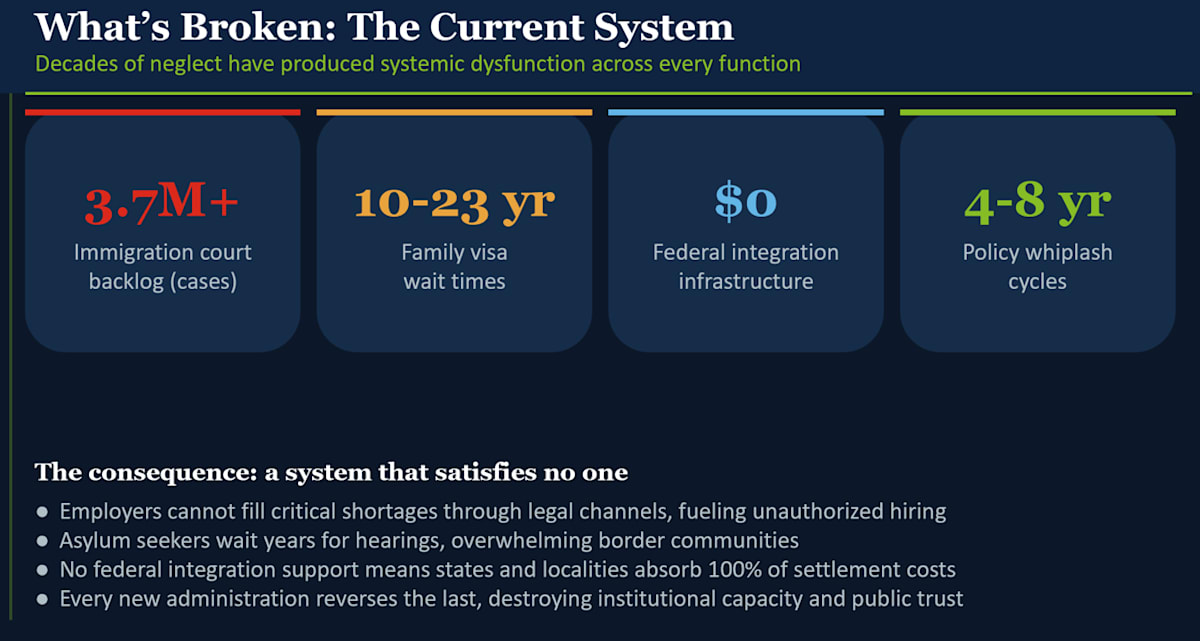
This is where the current U.S. system breaks down most visibly. GAO reported that EOIR had nearly 3.5 million pending cases as of July 2024, and DOJ later said the pending caseload was still under 3.75 million even after a major reduction in 2025. A future system should triage cases early, put clearly viable protection claims on fast merits dockets, move clearly nonviable claims quickly but fairly, and guarantee counsel for children and other vulnerable respondents.
The due-process case for counsel is also operational, not just ethical. GAO found that for non-detained respondents from FY2016–FY2023, the in absentia rate was 9% with legal representation and 75% without it; GAO explicitly said that is not proof of causation, but it is still a strong operational signal. The same report found a 34% overall in absentia rate for non-detained removal cases, varying by court location, legal representation, and demographics.
5) Narrow enforcement and detention dramatically
I worked for the Idaho Migrant Council many years ago. Most migrants are hard workers and contribute much to the cultural fabric of the United States. A few are problems. That's why I propose the following:
If policymakers decide ICE should not survive in its current form, the cleanest redesign is to split criminal investigation from civil immigration enforcement. Today, ERO manages the immigration enforcement process, while HSI conducts federal criminal investigations into smuggling, trafficking, contraband, money, and related crimes. In a redesign, HSI could remain the criminal-investigations arm, while civil custody, case management, supervision, and removals move into a smaller, tightly chartered civil agency with stronger statutory limits and transparency rules.
Detention should become the exception, not the default: reserved for people who pose a genuine public-safety threat, have serious flight risk, or have a final order and are actively evading compliance. For everyone else, the default should be supervised release and case management. GAO notes that ATD uses monitoring and case management to support court compliance, and ICE’s own archived ATD page said the daily cost per participant was under $4.20 compared with around $152 per day for detention.
6) Pair legal pathways with earned regularization
No U.S. reset will work if millions remain in a permanent shadow status while the economy keeps using their labor. The durable answer is earned legalization for long-settled undocumented residents with background checks, tax compliance, fees, and a staged path to permanent status. A narrower fast lane could apply to Dreamers, long-term farmworkers, and people married to U.S. citizens. That does not weaken the system; it clears legacy backlog out of the system so future enforcement can focus on current lawbreaking instead of unresolved history. The labor-force and demographic data are exactly why this is strategically different from simply expanding new inflows.
7) Fund migrant integration as core infrastructure
Social dollars that help people improve their capability give back in many ways.
The U.S. should stop treating integration as an afterthought. The package should include English-language grants, occupational bridge programs, licensing reciprocity compacts, local school and housing support, and employer co-funding for training. That is especially important in health care: OECD reported in 2025 that OECD health systems rely heavily on migrant doctors and nurses, with more than 830,000 foreign-born doctors and 1.75 million foreign-born nurses across the OECD in 2020–2021.
8) Move the courts out of day-to-day politics
My background in organization design leads me to the final recommendation.
EOIR ( Executive Office for Immigration Review) is part of DOJ today. A long-run stabilizer would be an independent Article I immigration court, with professional management, transparent data, and protected adjudicative independence. That would reduce policy whiplash between administrations and make court reform a governance project rather than a partisan tug-of-war. The backlog data alone show the current structure is not built for durable, high-volume adjudication.
Summary
The shortest way to summarize the model is this: more legal pathways, fewer illegal incentives; faster courts, less detention; narrower enforcement, stronger credibility; regional matching, better integration. That will satisfy all four things a serious immigration system has to do at once: protect the border, protect due process, meet labor-market reality, and preserve social legitimacy.