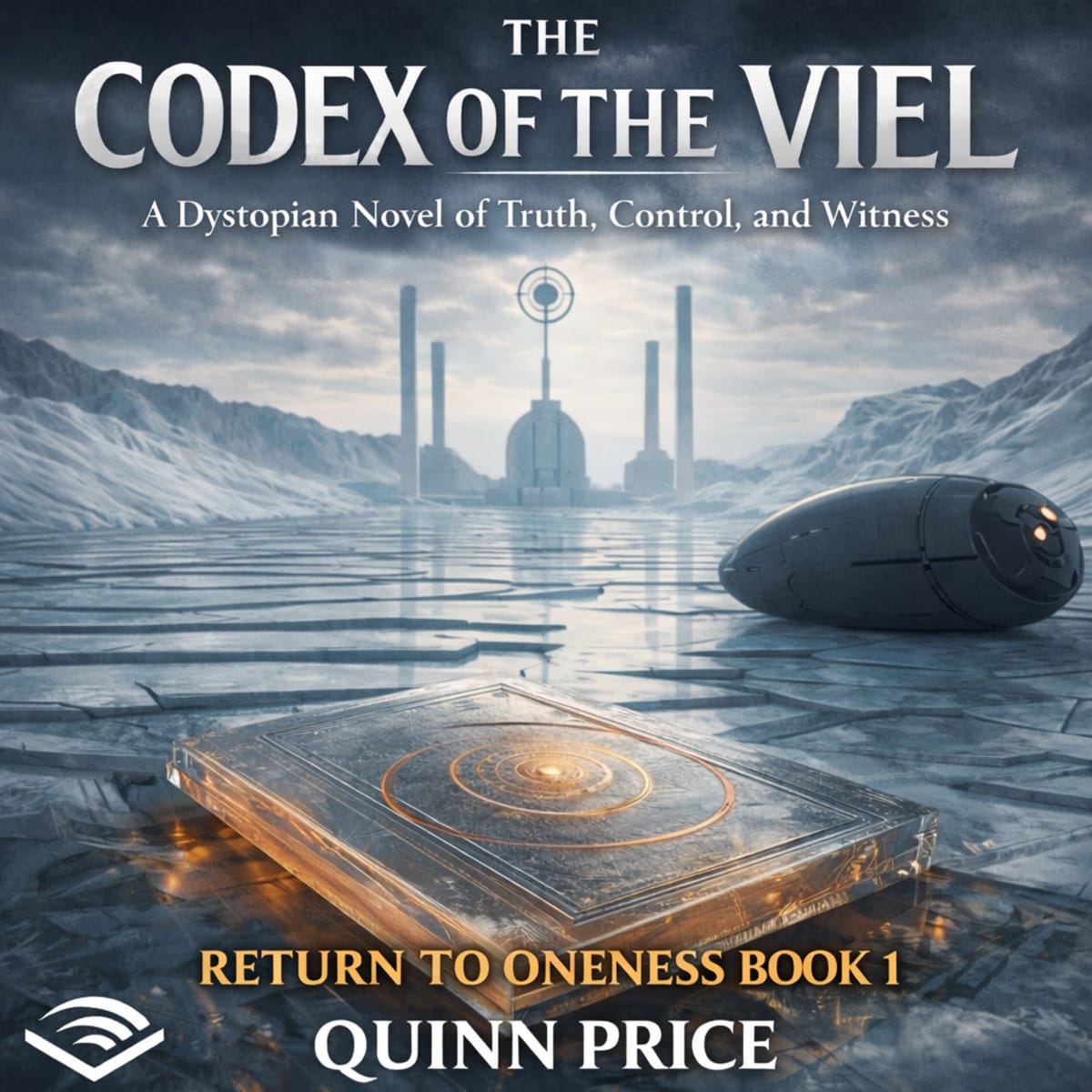
Here is something that keeps me up at night: how the human mind takes data and creates conclusions that support their goals and beliefs.
Start with something simple and beautiful. Something that cracks people open, dismantles their fear, and points at a reality bigger than the one they’ve been handed. Then watch what happens when an institution gets hold of it. Watch the lawyers arrive. Watch the interpretive layers accumulate. Watch the original spark get surrounded by scaffolding until no one can reach it anymore, and anyone who tries gets accused of doing it wrong.
I’ve spent forty years working inside organizations. I’ve watched this happen with corporate values, with mission statements, with DEI initiatives, with safety cultures. The mechanism is always the same: a simple and powerful idea gets institutionalized, and the institution gradually becomes more interested in managing the idea than expressing it. The teaching gets replaced by the management of the teaching. And before long, the management is the point.
So when I started reading serious Bible scholarship, not devotional commentary, but the kind of rigorous textual work that asks hard questions about who wrote what, when, for whom, and why, I recognized the pattern immediately. The mechanisms of institutional capture were right there in the historical record, hiding in plain sight underneath centuries of received interpretation.
That’s where The Codex of the Viel began.
The Bible Problem? It's a Human Problem
Let me be clear about something: this novel is not an attack on Christianity, or any religion. It’s about something far more universal and, frankly, more disturbing; what happens to any fact when it gets processed through human institutions.
Spend time with scholars who have mapped how early manuscripts were altered, harmonized, and shaped by scribes with theological axes to grind. The alterations aren’t rare anomalies; they’re pervasive. Texts were adjusted to resolve doctrinal disputes, silence competing factions, and establish authority. The manuscript tradition itself is, in part, a rhetorical record. The hand that copies the text also, almost inevitably, edits the text. And the hand that edits the text is always working within an institutional context that has interests.
None of this means the underlying experience that generated the teaching wasn’t real. It might have been profoundly real. But the experience and the institution built around the experience are two very different things, and conflating them has caused a remarkable amount of human suffering.
Oneness, as a concept, is actually simple. Embarrassingly simple. Strip away the vocabulary, the ritual, the hierarchy, and the interpretive apparatus, and every major contemplative tradition arrives at the same place: there is a unified field of awareness, you are part of it, and most of your suffering comes from forgetting that. That’s it. You could write it on a cocktail napkin.
But when that teaching runs into human ego, individual ego, certainly, but especially collective institutional ego, the simple becomes baroque. Because if the teaching is simple and available to everyone, then no one needs the institution. And institutions cannot afford that conclusion.
So the teaching gets complicated. Gatekeepers emerge. Approved vocabularies appear. Certification programs are established. And gradually, the thing the institution was supposedly created to transmit becomes the property of the institution, accessible only through official channels, interpretable only by credentialed authorities, dangerous in the wrong hands.
Sound familiar? It should. It’s not just religion. It’s every organization that has ever decided its most important job is protecting its own authority.
Why a Distant Planet? Why Tomas Rell?
Here’s the writing problem I had to solve: I wanted to explore these dynamics with full honesty, without the story being hijacked by readers’ existing allegiances. The moment I set this on Earth and name actual religions, half the audience is defending their tradition and the other half is gleefully attacking someone else’s. The specific overwhelms the universal.
So I went to a planet called Maren’s Reach, in a future where humanity has spread across star systems, and I gave it a governing body called the Dominion, an institution that controls meaning as much as it controls movement. The Dominion’s motto is “Order Is Mercy,” which tells you everything you need to know about how it sees its own role. It doesn’t just govern people. It governs interpretation.
And into this world I dropped Tomas Rell.
Tomas is not a hero in the traditional sense. He’s a cartographer, a mapper of the Outer Reaches, licensed by the Dominion, trained from childhood to survive by being useful and agreeable. He has no theological agenda. He’s not a rebel. He’s not a true believer. He is, deliberately, a man without a dog in the fight.
That’s exactly why I needed him.
The story I wanted to tell isn’t about someone who comes in already knowing the truth and fighting the institution. It’s about an ordinary person who stumbles into a direct encounter with something real, and then has to watch, from inside the institution, as that thing gets systematically processed into something else. Tomas doesn’t have a framework for what’s happening to him. He just has a conscience and the memory of what he actually experienced.
In my organizational work, I’ve met a lot of Tomases. People who joined an organization in good faith, witnessed something that troubled them, and spent years trying to reconcile what they saw with what they were being told to say. That reconciliation project is quietly exhausting in a way that doesn’t show up on performance reviews. Tomas Rell is for them.
The Discovery: Three Sparks in a Valley of Glass
The novel opens with Tomas searching for a missing survey team in the Valley of Glass at Kharon Ridge, a landscape of fractured crystal formations from some ancient cataclysm. What he finds instead is a crashed alien craft of enormous age, and inside it, a crystal slab that will change everything: the Codex.
His grandfather’s “seer stones,” cloudy crystal discs passed down through the family like a nearly-forgotten heirloom, turn out to be the interface. When Tomas holds them to the Codex, three transmissions come through before the slab goes silent:
“The Veil is not a punishment. It is an invention.”
“Fear is Love wearing armor.”
“Be the witness who sees what is, not the verdict.”
These aren’t doctrines. They’re not commandments. They’re orientation adjustments, small shifts in perspective that, if actually inhabited, would dissolve most of what we use to control each other. The Veil (the Dominion’s term for the separation between the material and the sacred) isn’t a fundamental condition of existence, it’s a managed concept. Fear isn’t the opposite of love, it’s love that has armored itself against too much pain. And witness-consciousness, the capacity to see clearly without immediately converting what you see into judgment, is the thing the entire teaching is trying to restore.
I spent years studying various contemplative traditions before I felt qualified to write those three lines. The content is not original to me. What’s original is the vessel I built to carry it.
The Machine Arrives
Tomas barely makes it back from Kharon Ridge before the Dominion finds the Codex. At the Sable Gate checkpoint, it’s confiscated for “review.” Tomas is assigned, not asked, assigned, as Provisional Translator in the Hall of Tongues.
What follows is the organizational dynamics section of the novel, and I will confess I had perhaps too much fun writing it.
Special Counsel Rourke Vance is the smoothest kind of institutional operator: the man who has learned to perform sincerity so well he’s almost forgotten he’s performing. Sister Nara holds doctrinal authority and is genuinely frightened of what the Codex says, not because she disbelieves it, but because she can see exactly how it threatens the architecture her life has been built around. General Koss handles behavioral control: the enforcement arm that doesn’t need to understand the content, only the compliance metrics. And Inspector Calix Mere, from Archive Integrity, watches everything and writes things down.
Tomas, caught in the middle of these competing agendas, does what any reasonable person does when they’re in an impossible institutional position: he creates two translation drafts. A faithful one, what the Codex actually says. And an official one, what the Dominion needs it to say. He tells himself he’ll figure out what to do with the faithful draft later.
This is not cowardice. This is the deal that millions of people make every day with institutions they depend on. I wanted to honor the complexity of that position rather than judge it.
When Witness-Consciousness Becomes a Surveillance Program
This is the part of the novel that disturbs people most, and it’s meant to.
The Dominion’s handlers recognize that Tomas’s youth gloss on witness-consciousness—a simplified version he wrote for educational materials, built around the phrase “Witness what is, first” has extraordinary potential. Children respond to it. It’s accessible. It’s memorable.
So they build a program around it. The Directorate of Witness Training. Youth Witness Protocol. Two hundred schools. And “Witness what is, first” gets quietly redirected. Instead of teaching children to see clearly without judgment, it teaches them to report concerning behaviors. Their parents’ concerning behaviors, specifically. The Dominion creates, using the language of a liberation teaching, one of the most effective youth surveillance networks in the history of the planet.
Guard Captain Sorren, assigned to escort and monitor Tomas, discovers this when his own daughter, fully trained in the Youth Witness Protocol, reports him.
The mechanism I’m describing is not fictional. It has happened in authoritarian regimes with disturbing regularity. It has happened in high-control religious communities. It has happened, in subtler forms, in corporate cultures that incentivize employees to report non-compliance. The transformation of a teaching about clear seeing into a tool for institutional monitoring is one of the most reliable moves in the institutional playbook.
I wanted it in the novel because I wanted readers to recognize it, to feel the moment when something they might have applied simply and powerfully in their own life gets weaponized. That recognition is uncomfortable. It’s supposed to be.
The Underground and the Seventh Seal
Running parallel to Tomas’s institutional entanglement is a network that has been operating quietly for generations: Archivist Malen Vale, who has spent decades curating marginalia and hidden fragments that predate the Dominion’s approved interpretations. Clerk Iria Halm, who moves truth through logistics and deniable gestures, the kind of person institutions consistently underestimate because she makes the filing system work. Lysa in the bindery, who has tracked the pattern for fifteen years and knows where every dead drop is. A hidden room behind Shelf 9K. Messages in lamp bases.
And Kellen Dresh, the Collector, custodian of what he calls the third line: eleven generations of preserving the teaching across empire cycles. It was Kellen who stole the Codex from the Dominion vault and left behind a single note: IT IS UNSAFE HERE.
The Codex, it turns out, is one of seven artifacts arranged in a constellation pattern across pre-settlement sites on Maren’s Reach. The Seventh Seal that the Dominion is desperately trying to locate and control is not a missing paragraph or a hidden chapter. It is a gathering condition: seven witnesses, unmeasured and uncoerced, holding witness-consciousness simultaneously.
The teaching is, by design, ungovernable. It withdraws under coercion. It blooms under patience. You cannot force it open, you can only create conditions where it wants to open. The Dominion’s fundamental error is believing that the thing they’re trying to control is a text. It isn’t. The text is just a map. The territory is a state of being, and states of being cannot be legislated.
This is the theological argument at the heart of the novel, and I believe it.
The Hearing, and What Witness-Consciousness Actually Looks Like
The climax of the novel is not a battle. There are no explosions. Tomas returns to Meridian voluntarily and negotiates a public hearing, not to win, but to testify.
He exposes the fabricated divine origin story the Dominion built around him. He names the distortion of witness-consciousness into surveillance. He describes what the youth program is actually doing to families. And he does it without armor, without the defensive positioning, the careful hedging, the strategic ambiguity that institutional self-preservation requires.
The seer stones, sitting on the table in front of him, begin to glow.
During the chaos that follows, Malen, Iria, and Lysa escape with what they’ve been protecting. A parent named Denna whose child was in the youth program, who came to the hearing not knowing what she was walking into, becomes the seventh witness. The Seventh begins to open in the hearing room itself. The teaching does exactly what it was designed to do: it finds the unmeasured and the uncoerced, and it blooms.
Tomas is arrested. He is not moved. “The cage is real,” he says. “But I’m not in it.”
That line took me a long time to find. But once I found it, I knew it was the whole book in eight words.
Why This Story, Why Now
I’ve written several business books. I know how to package ideas for organizational consumption. I know the language of competencies and frameworks and implementation roadmaps. That work matters and I stand behind it.
But there is a category of truth that does not survive that packaging. That gets flattened by the very efficiency with which we try to transmit it. Witness-consciousness is in that category. The experience of genuine non-separation, of the Veil being, as the Codex says, an invention rather than a fundamental reality, cannot be delivered in a training module. It can only be pointed at, stumbled into, and recognized.
Fiction can point. It can create the conditions for recognition in a way that non-fiction, with its obligation to argument and evidence, sometimes cannot. Tomas Rell’s journey, from compliant cartographer to reluctant translator to willing witness, is a map. Not of a distant planet, but of the territory most of us are already navigating.
We are all, in various ways, inside institutions that were built to transmit something real and have since become more interested in managing their own authority than expressing the thing they were made for. We are all, at some level, maintaining two drafts: what we actually see and what we’re authorized to say.
The Codex of the Viel is an invitation to stop maintaining two drafts.
The cage may be real. But you’re not in it.