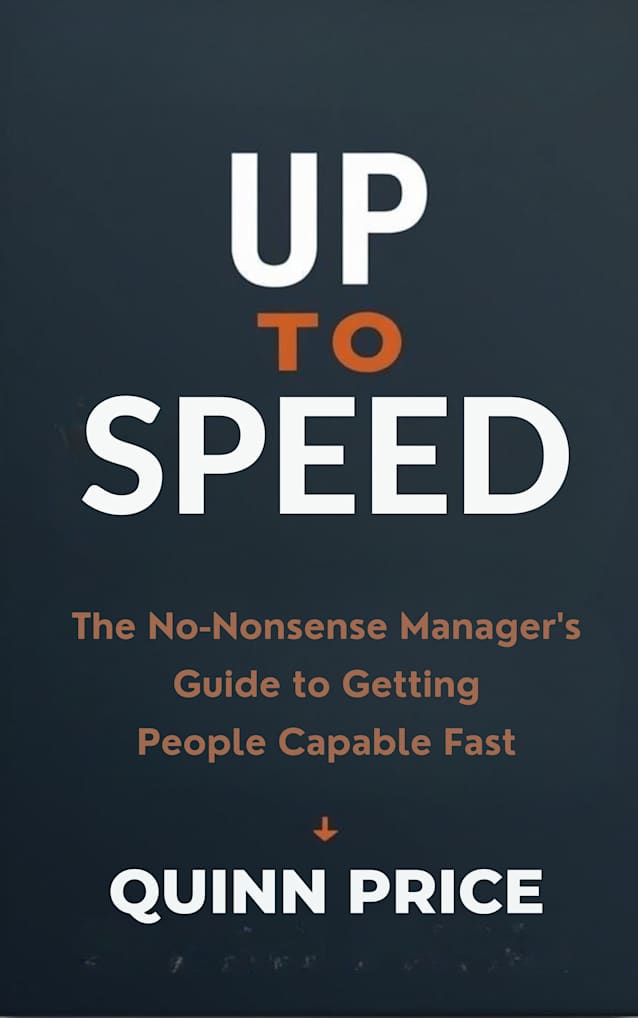
Up to Speed
About
Most managers are developing their teams by accident. This book makes it deliberate and faster than you thought possible.
You were promoted because you were good at the work. Nobody told you that management is a completely different job, one where your value is no longer what you can do but what you can get other people to do. And nobody gave you a system for closing the gap between the team you have and the team you need.
So you improvised. You hired when positions opened and hoped for the best. You onboarded people by pointing them at the job and watching what happened. You gave feedback when things went wrong and called it development. You carried the work that made you nervous rather than building the capability to trust it to someone else.
You learned by swimming in the deep end. Your people are learning the same way.
Up to Speed: The No-Nonsense Manager's Guide to Getting People Capable Fast is the book that changes that equation, without adding a training program, a coaching certification, or a three-day offsite to your already full plate.
What the best talent-development environments have in common
The NFL, elite law firms, police academies, and surgical residency programs have nothing obvious in common, except that they cannot afford to develop talent slowly. Through very different paths, they have all arrived at the same handful of principles: define capable before you start, use real work as the training ground, combine high repetition with immediate feedback, and stay alongside people through the messy middle rather than abandoning them between orientation and autonomy.
Those principles work in your team too. This book shows you exactly how to apply them.
What you'll find inside
Up to Speed gives you a complete, practical system for getting people capable fast, built around the decisions managers actually face.
The Up to Speed Ramp: a three-phase framework that takes any new hire from lost to fully functional in sixty days, including the one phase almost every manager skips and the reason that gap is costing them months of underperformance.
Hiring for learning velocity: why the person with the best resume is rarely the person who will be most capable in ninety days, and the three interview questions that identify the fast learners your current process is probably filtering out.
Onboarding as investment: why the first thirty days determine more about long-term performance than the next twelve months combined, and what the manager who owns that period deliberately gets that the manager who delegates it to HR never will.
The two-minute feedback habit: a daily micro-practice that replaces performance reviews, compounds invisibly over eight weeks, and eventually produces a team that calibrates itself without you at the center of every conversation.
The talent audit: three honest questions, asked once a quarter, that tell you exactly where your bench stands before the gap becomes a crisis.
Stretch assignments done right: the highest-return development tool available to any manager, and the framework that converts a challenging assignment into genuine capability rather than prolonged stress.
Who this book is for
Up to Speed is written for the manager who knows talent development matters and has never quite found the time to do it properly. The manager who is carrying more than they should and is tired of it. The manager who is watching peers get promoted and suspects, correctly, that their team's capability is the variable that explains the difference.
It is not a book for HR professionals designing enterprise learning programs. It is a book for the manager of a team of five to twenty people who needs their people capable fast, does not have a training department to lean on, and wants a system that works in the real world rather than the world that management books usually describe.
The promise
Every manager develops their team, either by accident or by design. The accidental version produces teams that are permanently behind where they need to be and managers who are permanently carrying the weight of that gap.
The designed version produces something different: a team that keeps getting better, a manager whose career keeps moving forward, and a Sunday night that is quiet enough to actually rest.
Read it over the weekend. Apply it Monday.